Understanding the 'UDS' (Undivided Share) in Large-Scale Townships
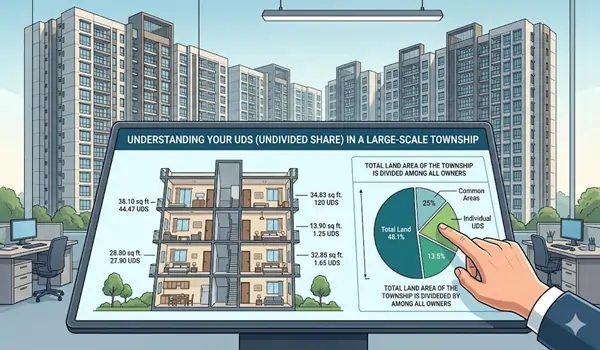
When you buy a home in a massive township like Purva Northern Lights in Bangalore, you are buying more than just a floor, four walls, and a ceiling. You are buying a piece of the sky and a piece of the earth. In the real estate world, that piece of earth is called UDS, or Undivided Share.
If you are a first-time homebuyer, "Undivided Share" might sound like complex legal jargon. However, it is the most important part of your property papers. It determines the true value of your investment over time.
In this guide, we will break down everything you need to know about UDS in simple words.
What exactly is UDS?
In a standalone house, you own the land and the building. In an apartment or a large-scale township, many families live on the same plot of land. Since the land cannot be physically divided into separate plots for each owner, it is shared.
UDS is your share of the land on which the entire building stands.
It is "undivided" because you cannot point to a specific corner of the garden or the parking lot and say, "This square inch is mine." Instead, you own a percentage of the entire land parcel.
Why is UDS Important?
Many buyers focus only on the "Built-up Area" or the "Carpet Area." While these are important for your daily living, UDS is important for your wealth.
- The Appreciation Factor: The building (the bricks and mortar) loses value over time. It wears out. However, the land appreciates in value. Your profit when you sell the flat in the future depends heavily on your UDS.
- Legal Ownership: Your right to the property is legally tied to the UDS.
- Redevelopment Rights: If the building is demolished after 40 or 50 years, the new building will be divided based on the UDS you held.
- Compensation: If the government acquires the land for a road or Metro, the compensation is paid based on the UDS.
UDS in Large-Scale Townships
In a large township, UDS works slightly differently than in a single-tower apartment. Townships often have:
- Massive open spaces.
- Clubhouses and swimming pools.
- Large internal roads.
- Garden areas and parks.
Your UDS includes a portion of all these common areas. This is why buying in a large-scale project is often seen as a better land investment than buying in a crowded, small apartment block.
Key Benefits of UDS in Townships:
- Greater Open Space: Townships usually have lower ground coverage. It means more land is left open, potentially giving you a healthier UDS ratio.
- Future Proofing: If a township sits on 20 acres of prime land, a small percentage of that 20 acres is a significant asset as the city grows around it.
The Role of the Agreement of Sale
When you sign your papers, ensure the UDS is mentioned clearly.
- The Agreement of Sale should specify the exact UDS in square feet or square meters.
- Check if the UDS promise matches the UDS mentioned in the Sale Deed during registration.
- If there is a mismatch, it can lead to legal issues during resale.
Common Mistakes Buyers Make
- Ignoring the UDS: Some buyers focus only on the marble flooring or the view. They forget to ask how much land they actually own.
- Not Verifying with RERA: Always check the RERA (Real Estate Regulatory Authority) filings of the project. The UDS promised to the government must match what is promised to you.
- Car Parking Confusion: Usually, a dedicated car park increases your UDS. Make sure this is documented.
UDS and Home Loans
Banks are very strict about UDS. When you apply for a home loan, the bank's legal team will verify the UDS.
If the UDS is not clearly defined or the builder has sold more UDS than the available land, the bank will reject the loan.
A clear UDS is a "green flag" for banks, signifying a safe and legal property.
Living the Dream at Purva Northern Lights
The UDS concept is handled with complete transparency at Purva Northern Lights. Located in the fast-growing Greater North Bangalore, this project offers a mix of modern luxury and vast open spaces. Because it is a planned township, the land-to-building ratio is optimized.
This ensures that residents not only enjoy a premium lifestyle but also hold a valuable share of the land in one of Bangalore's most promising corridors.
Conclusion
To put it simply, UDS is the "real" part of your real estate. When a building gets old, the flat loses value, but the land underneath it stays valuable. By owning a home in a large township, you own a part of a very big and expensive piece of land.
In projects such as Purva Northern Lights Bangalore, you are getting more than just a luxury home. You are getting a legal share of a massive 25-acre estate. As North Bangalore grows and the airport area becomes a city center, that share of land will become your biggest financial strength. You must always remember that you buy the flat for today, but you buy the UDS for tomorrow.




 24/7 Support
 Free Site Visit
 Unmatched Price